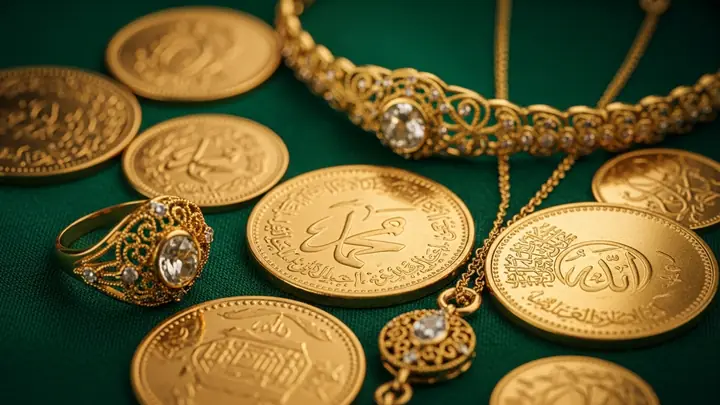
Zakat on Jewellery UK 2026
Zakat is due on the gold and silver content of jewellery at 2.5%. Whether jewellery you wear is included depends on your school of thought — the Hanafi school includes it; others may exempt it.
Last reviewed: June 2026 · By World Aid Network
Do you pay Zakat on jewellery you wear?
This is the single most common Zakat question among UK Muslim families, especially around weddings and gold gifts. The answer differs by madhab (school of Islamic law):
Hanafi school
Jewellery is zakatable — whether worn or stored. Gold and silver are treated as inherently monetary, so personal use does not exempt them. This is followed by most Muslims of Pakistani, Indian, and Bangladeshi heritage in the UK.
Maliki · Shafi'i · Hanbali
Worn jewellery is exempt when used for legitimate personal adornment within customary amounts. However, jewellery stored as savings, held as investment, or beyond customary use remains zakatable.
If you are unsure which school you follow, or wish to take the safer, more rewarding position, include all gold and silver jewellery in your calculation. Many UK scholars recommend this precaution.
What jewellery is — and isn't — zakatable
| Item | Zakatable? | Notes |
|---|---|---|
| Gold jewellery | Yes (Hanafi); conditional (other schools) | 2.5% of pure-gold value |
| Silver jewellery | Yes (Hanafi); conditional (other schools) | 2.5% of pure-silver value |
| Diamonds, gemstones, pearls | No | Exempt unless held as trade stock |
| Platinum & palladium | No | Not classed as zakatable metals for personal use |
| Costume / imitation jewellery | No | No gold or silver content |
| Gold/silver kept as investment | Yes (all schools) | Always zakatable |
How to calculate Zakat on jewellery — step by step
- Separate by metal: group your gold and silver pieces separately. Set aside anything that is purely diamond, platinum, or gemstone.
- Weigh the precious metal in grams (ignore the weight of stones and settings where possible).
- Adjust for carat purity: multiply weight by (carat ÷ 24). For example 22ct gold × 0.917.
- Apply today's spot price per gram for gold or silver.
- Add to your other zakatable wealth (cash, savings, investments).
- Check the Nisab — if your combined total exceeds the silver Nisab (≈ £1,065), Zakat is due.
- Pay 2.5% of the total.
Worked example — a bridal gold set
Aisha owns a 22-carat gold bridal set weighing 80 grams, plus £1,500 in savings. She follows the Hanafi school.
- Pure gold: 80 × (22 ÷ 24) = 73.3g
- Gold value at ~£106/g: 73.3 × £106 = £7,769.80
- Total zakatable wealth: £7,769.80 + £1,500 = £9,269.80
- Nisab check: £9,269.80 > ~£1,065 (silver Nisab) ✓
- Zakat due: £9,269.80 × 2.5% = £231.75
Carat purity reference
| Carat | Purity | Multiply weight by |
|---|---|---|
| 24ct | 99.9% | 1.000 |
| 22ct | 91.7% | 0.917 |
| 21ct | 87.5% | 0.875 |
| 18ct | 75.0% | 0.750 |
| 14ct | 58.3% | 0.583 |
| 9ct | 37.5% | 0.375 |
Common situations
Broken or unworn jewellery: Always zakatable in every school — if it is stored rather than worn, the personal-use exemption does not apply.
Inherited jewellery: Once it is in your ownership and you have held it for a lunar year, it is treated like any of your gold/silver. See our Zakat on inheritance guide.
Children's gold: Most scholars hold that a minor's wealth (including gifted gold) is not subject to Zakat until adulthood, though the Hanafi position requires Zakat on a child's gold and silver in some views — check with your local scholar.
Frequently asked questions
Do I pay Zakat on jewellery I wear every day?
It depends on your school of thought. In the Hanafi school (followed by most South Asian Muslims in the UK), Zakat is due on all gold and silver jewellery — including pieces worn daily — because gold and silver are intrinsically monetary. In the Maliki, Shafi'i, and Hanbali schools, jewellery worn regularly for personal adornment (within customary limits) is exempt. To be cautious, many UK Muslims include all gold and silver jewellery regardless of school.
Is Zakat due on diamond, platinum, or gemstone jewellery?
No. Zakat is only due on the gold and silver content of jewellery. Diamonds, platinum, pearls, gemstones, and other precious stones are exempt unless they are bought and held as trade stock for resale. If a ring is platinum with diamonds and contains no gold or silver, no Zakat is due on it for personal use.
How do I calculate Zakat on mixed jewellery?
Weigh only the gold or silver portion of each piece and adjust for purity (carat). For example, 22-carat gold is 91.7% pure, so multiply its weight by 0.917 to get pure-gold grams. Multiply pure grams by the current spot price, then pay 2.5% of the total value. Ignore the weight of any stones or non-precious settings.
Is wedding jewellery (e.g. a gold set or bangles) zakatable?
In the Hanafi school, yes — a gold wedding set, bangles, necklaces, and bridal gold are all zakatable at 2.5% of their gold value. This is one of the most common Zakat questions for UK families. In other schools, regularly worn bridal jewellery may be exempt, but gold kept in storage as savings is zakatable in all schools.
Do I pay Zakat on jewellery at the price I bought it or today's price?
Today's market (spot) value of the gold or silver — not the purchase price and not the retail jeweller's price. Use the scrap/spot value of the precious metal content on your Zakat anniversary (Hawl date).
Is jewellery zakatable if it is below the Nisab?
Zakat on jewellery is assessed together with your other zakatable wealth (cash, savings, other gold/silver). If your combined total exceeds the Nisab — approximately £1,065 using the silver standard — then Zakat is due on everything, including the jewellery, even if the jewellery alone is below the threshold.
Who pays the Zakat on a wife's jewellery — her or her husband?
The owner of the jewellery is responsible for its Zakat. If the jewellery belongs to the wife, the Zakat is technically her obligation, though a husband may pay it on her behalf with her permission. Ownership, not who bought it, determines responsibility.