
Zakat is an individual obligation. A woman’s gold, mahr, savings and inheritance belong to her, so the Zakat on them is hers if her own net wealth reaches nisab; they are not added to her husband’s wealth. A husband may pay on her behalf with her agreement, but he is not obliged to.
Each spouse is assessed separately
There is no household Zakat. Each adult Muslim adds up what they personally own, subtracts their own debts due and compares the result with nisab. NZF describes Zakat as an individual obligation for which each spouse is responsible.
Do not pool a couple’s wealth and do not split it evenly by default. A joint account is divided according to who actually owns the money. Jewellery given to the wife is hers; savings in the husband’s name are his.
Gold and jewellery she wears
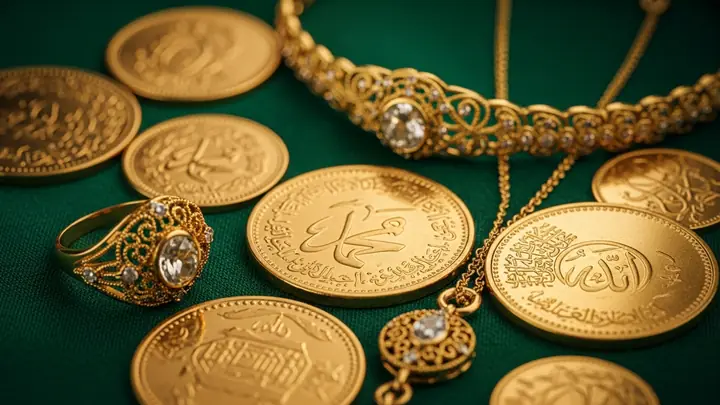
This is the question that changes most women’s calculation, and scholars differ. The Hanafi school includes gold and silver jewellery in Zakat even when it is worn. The Maliki, Shafi’i and Hanbali schools generally exempt permissible jewellery kept for personal use, with conditions.
Under the Hanafi approach, gold is counted by weight and purity, and its value is combined with cash and silver. A woman with modest savings and a wedding set can therefore be above nisab. Weigh each item, note the carat and use the gold Zakat calculator. See Zakat on jewellery for the rulings.
Mahr: received and unpaid
Mahr that has been paid is the wife’s property. Cash is counted as cash and gold as gold, like anything else she owns.
Mahr that was agreed but has not yet been paid is money owed to her. Scholars differ on whether Zakat is due on it before she receives it, and on whether a husband may deduct it from his own wealth. Do not assume either. Record the amount and ask a qualified scholar which view applies to you.
If she has gold but little cash
The obligation stays with the owner. She can pay from her own money, sell a small part of the gold, or pay in instalments before the next due date. Her husband or another relative can also pay for her as a gift, provided she knows and agrees, because Zakat requires the owner’s intention.
Amina owns 60g of 22ct gold and £400 in savings. Pure gold: 60 × 22 ÷ 24 = 55g. At an illustrative £90 per gram that is £4,950; with her savings, £5,350.
Under the Hanafi approach, if that total is above nisab and a lunar year has passed, her Zakat is £5,350 × 0.025 = £133.75. Under a school that exempts her personal jewellery, only the £400 is assessed, which is below the illustrative nisab, and nothing is due.
Can spouses give Zakat to each other?
A husband cannot give his Zakat to his wife, because he is already obliged to maintain her. Whether a wife may give her Zakat to a husband who is poor is disputed between scholars. See can Zakat go to family members?
Common questions
Does a husband have to pay Zakat on his wife’s gold?
Do housewives pay Zakat?
Is Zakat due on wedding gold I never wear?
Is my husband’s wealth added to mine to reach nisab?
Sources & calculation method
These sources inform this guide. A linked source does not endorse this site, and its publication date may differ from this page’s update date.
- National Zakat Foundation: Zakat as an individual obligation for spouses and mature children
- National Zakat Foundation: who has to pay Zakat?
- Zakat Foundation of America: assessment and jewellery differences
- National Zakat Foundation: understanding and calculating Zakat
Scholarly methods can produce different results. See the method choices that affect a Zakat estimate and our editorial policy. This is educational guidance, not a personal ruling or a claim of named scholarly review.
To cite this guide: “Zakat for women: jewellery, mahr and who pays”, World Aid Network, updated 12 November 2026, https://zakat-calculator.org.uk/zakat-for-women